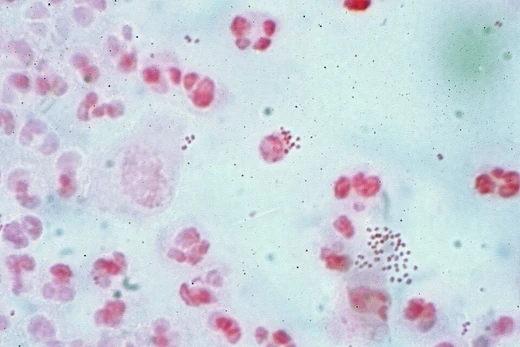
Mycobacterium leprae
First bacterium identified as a cause of human disease.

Mycobacterium leprae, also known as the leprosy bacillus or Hansen's bacillus, is one of the two species of bacteria that cause Hansen's disease (leprosy), a chronic but curable infectious disease that damages peripheral nerves and targets the skin, eyes, nose, and muscles. It is an acid-fast, Gram-positive, rod-shaped bacterium and an obligate intracellular parasite, meaning it cannot be grown in cell-free laboratory media, likely due to gene deletion and decay from reductive evolution.
- discovered_by
- Gerhard Armauer Hansen
- type
- Bacterium
- disease_caused
- Hansen's disease (leprosy)
- host_range
- Humans, nine-banded armadillos, red squirrels
Lore & Background
Mycobacterium leprae is an intracellular, pleomorphic, non-sporing, non-motile, acid-fast, pathogenic bacterium. It is an aerobic bacillus with parallel sides and round ends, surrounded by a waxy coating of mycolic acid. It is Gram-positive but traditionally stained with carbol fuchsin in the Ziehl–Neelsen stain; the Fite-Faraco staining method is now used due to its lower acid concentration. The bacteria are found in granulomatous lesions, especially numerous in nodules, and often occur in large numbers within lesions of lepromatous leprosy, grouped together as a palisade. By optical microscopy, they can be found singly or in clumps called 'globi,' straight or slightly curved, 1–8 μm long and 0.3 μm in diameter. They grow best at 27 to 30 °C, making skin, nasal mucosa, and peripheral nerves primary targets.
Reader's Guide
Mycobacterium leprae's significance lies in its role as the causative agent of leprosy, a disease with global distribution, highest prevalence in sub-Saharan Africa, Asia, and South America. The bacterium's obligate intracellular nature and inability to be cultured in cell-free media have hindered research, but animal models using mice and armadillos have been developed. Treatment evolved from dapsone alone, to which resistance developed by the 1960s, to a multidrug therapy recommended by the World Health Organization, including dapsone, rifampicin, and clofazimine. The bacterium's narrow host range includes humans, nine-banded armadillos, and red squirrels, with armadillos implicated as a zoonotic source.
Did You Know?
- Mycobacterium leprae has an unusually lengthy doubling time of 12 to 14 days, compared to 20 minutes for Escherichia coli.
- It can only be grown in laboratory settings using mouse foot pads or armadillos due to its inability to be cultured in cell-free media.
Frequently Asked Questions
What are Mycobacterium leprae's powers/role?
This obligate intracellular parasite specifically targets peripheral nerves, skin, eyes, nose, and muscles, slowly damaging them over time. Because it absolutely cannot grow in cell-free lab media, it has shed large chunks of its genome through reductive evolution, making it dependent on a living host for survival.
How does Mycobacterium leprae's story end?
Hansen's disease is chronic but entirely curable, so the bacterium can be fully eradicated with the right antibiotic regimen. A diagnosis is not a life sentence; with proper treatment the infection is cleared and nerve damage can be stabilized.
Who can Mycobacterium leprae infect?
Humans are the primary host, but the bacterium can also establish infection in nine-banded armadillos and red squirrels. These animal reservoirs matter because they can carry and spread the organism outside human populations.
More in Pathogenic Bacteria 1-20
Spotted an error? Know more?
This is a living reference — every entry is fact-audited, and reader corrections feed straight into our audit queue. Suggest an edit · See this site's audit record