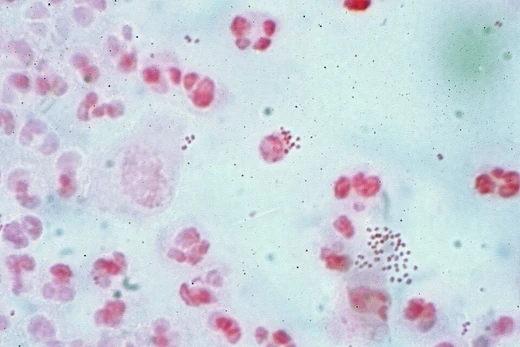
Haemophilus influenzae
A pathogenic bacterium once mistaken for the cause of influenza.

Haemophilus influenzae is a Gram-negative, non-motile, coccobacillary, facultatively anaerobic, capnophilic pathogenic bacterium of the family Pasteurellaceae. The bacterium is responsible for a wide range of localized and invasive infections, typically in infants and children, including pneumonia, meningitis, and bloodstream infections.
- Type
- Gram-negative, non-motile, coccobacillary bacterium
- Family
- Pasteurellaceae
- Optimal growth temperature
- 35–37 °C
- Known for
- First free-living organism to have its entire genome sequenced; cause of Hib infections; development of Hib vaccine in the 1980s
Lore & Background
The species was the first organism to have its entire genome sequenced, completed by Craig Venter and his team at the Institute for Genomic Research, now part of the J. Craig Venter Institute.
Reader's Guide
Haemophilus influenzae is significant as a major cause of invasive infections in infants and children, particularly meningitis, pneumonia, and bloodstream infections. Serotype b (Hib) was a leading cause of meningitis in young children, frequently causing deafness and mental degradation. The development of the Hib vaccine in the 1980s has almost eliminated this disease in developed countries. The bacterium also holds historical importance as the first free-living organism to have its entire genome sequenced, paving the way for modern genomics. Its genome sequencing demonstrated the whole-genome shotgun method and revealed that about 90% of its genes have homologs in E. coli. Antibiotic resistance is a concern, with many isolates resistant to penicillin, leading to changes in treatment from ampicillin to cephalosporins, though further resistance has emerged. The bacterium's ability to form biofilms and its specialized pili for adhesion contribute to its pathogenicity.
Did You Know?
- The Hib vaccine, developed in the 1980s, has almost eliminated Hib infections in developed countries.
- H. influenzae pili resist unwinding, allowing stronger adhesion to the human nasopharynx to resist expulsion when coughing or sneezing.
A Name Born of Mistake: The Pfeiffer Story
The story of Haemophilus influenzae begins with a dramatic misidentification. That error in judgment, however, proved to be the bacterium's permanent identity: the species was christened "influenzae" in direct reference to the disease it was wrongly blamed for causing. Pfeiffer's bacillus, as it was also known, carried that misleading name for decades before microbiologists finally untangled the true etiology of influenza. Despite the naming confusion, the organism itself is a well-defined member of the family Pasteurellaceae—a Gram-negative, non-motile, coccobacillary, facultatively anaerobic, and capnophilic pathogen. It thrives in the mesophilic range, with optimal growth between 35 and 37 degrees Celsius, conditions that mirror the human body's internal environment. What Pfeiffer stumbled upon in a moment of pandemic urgency turned out to be a far more complex and persistent human pathogen than the simple influenza agent he had imagined.
Hib and the Arms Race Against Resistance
Few bacterial pathogens have shaped public health policy as profoundly as Haemophilus influenzae, particularly its type b serotype, known as Hib. Before the 1980s, Hib was a leading cause of bacterial meningitis in infants and young children, and survivors frequently endured devastating sequelae including permanent deafness and significant cognitive impairment. The bacterium's arsenal extends well beyond the meninges; it is responsible for a broad spectrum of both localized and invasive infections in vulnerable populations, including pneumonia and bloodstream infections. Managing these infections has been an ongoing arms race. The organism is frequently resistant to the penicillin family, though amoxicillin combined with clavulanic acid remains an option for milder presentations. When beta-lactamase-producing strains emerged in the 1970s, clinical guidelines shifted from ampicillin to cephalosporins for severe cases. Yet resistance continued to evolve, with modifications in the transpeptidase domain of penicillin binding protein 3 conferring tolerance to cephalosporins as well. The development of an effective Hib vaccine in the 1980s, targeted specifically at the age group most at risk, has nearly eradicated Hib disease in developed nations, standing as one of the great triumphs of preventive medicine.
Engineering Adhesion: Pili, Autotransporters, and Biofilms
Despite its diminutive size—ranging from roughly 0.3 to 1 micrometer—Haemophilus influenzae is a master of surface attachment. Its cell envelope follows the classic Gram-negative architecture: a thin peptidoglycan sandwiched between the inner membrane and an outer membrane studded with lipopolysaccharide. Certain encapsulated strains wrap themselves in an additional polysaccharide shell that aids both protection and colonization. The bacterium is pleomorphic, shifting between coccobacillary and rod-like forms, yet it remains firmly non-motile. Its pili, however, are far from decorative. Unlike the pili of Escherichia coli, those of H. influenzae resist mechanical unwinding, granting them a tenacious grip on the human nasopharynx that withstands the force of coughing and sneezing. Non-typeable strains supplement pili with adhesins and specialized Hia and Hap proteins. The Hap autotransporters embedded in the cell wall latch onto as-yet-unidentified receptors on mucus linings and non-ciliated epithelial cells, simultaneously promoting the assembly of microcolonies. These microcolonies are believed to be the precursors of the biofilms that drive middle-ear and pulmonary infections, anchoring the bacterium firmly within its host.
First in the Queue: The 1995 Genome Milestone
The landmark effort was led by Craig Venter and his colleagues at the Institute for Genomic Research, an institution that would later become the J. Craig Venter Institute. The project's selection of this particular bacterium was no accident; Nobel laureate Hamilton Smith, one of the project's senior figures, had spent decades studying H. influenzae and was able to supply high-quality DNA libraries that made the work feasible. The team employed the then-novel whole-genome shotgun strategy, and the results were published in the journal Science. Remarkably, roughly ninety percent of these genes share homologs with Escherichia coli, another gamma-proteobacterium, with protein sequence similarity spanning a wide range from 18 to 98 percent. That single sequencing milestone opened the door to the modern era of genomics and redefined what was possible in microbial biology.
Frequently Asked Questions
Who is Haemophilus influenzae?
Haemophilus influenzae is a small, non-motile, Gram-negative coccobacillus in the Pasteurellaceae family that thrives in warm, oxygen-poor environments around 35–37 °C. Despite its dramatic name, it has absolutely nothing to do with the influenza virus itself.
What are Haemophilus influenzae's powers/role?
This bacterium specializes in causing both localized and invasive infections—pneumonia, meningitis, and bloodstream sepsis—primarily targeting infants and young children. As a facultatively anaerobic, capnophilic organism, it can flex between aerobic and anaerobic metabolism to survive in varied host niches.
How does Haemophilus influenzae's story end?
The dramatic arc of invasive Hib disease was largely defused in the 1980s with the rollout of the conjugate Hib vaccine, which slashed rates of meningitis and sepsis in children. The bacterium still lingers as a cause of localized infections, but its once-feared invasive reign has been largely tamed.
More in Pathogenic Bacteria 1-20
Spotted an error? Know more?
This is a living reference — every entry is fact-audited, and reader corrections feed straight into our audit queue. Suggest an edit · See this site's audit record