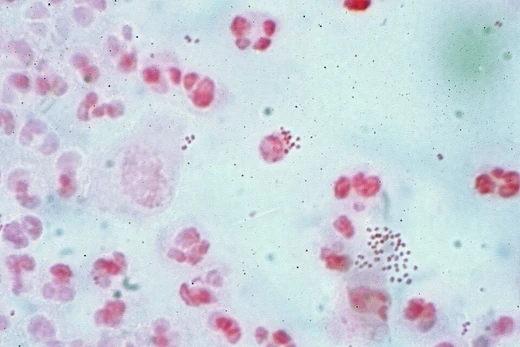
Escherichia coli
A model bacterium central to microbiology and biotechnology.

Escherichia coli is a gram-negative, facultative anaerobic, rod-shaped, coliform bacterium commonly found in the lower intestine of warm-blooded organisms. Most strains are part of the normal gut microbiota, where they constitute about 0.1% of the population, and are mostly harmless or beneficial, such as by producing vitamin K2 or preventing colonization by harmful pathogens. Some serotypes, however, are pathogenic and cause serious food poisoning via fecal–oral transmission.
- type
- Gram-negative bacterium
- morphology
- Rod-shaped, 2.0 μm long, 0.25–1.0 μm diameter
- habitat
- Lower intestine of warm-blooded organisms
- metabolism
- Facultative anaerobe, chemoheterotroph
- reproduction
- Binary fission, as fast as 20 minutes under favorable conditions
- significance
- Most widely studied prokaryotic model organism; host for majority of recombinant DNA work
Lore & Background
Escherichia coli is a gram-negative, facultative anaerobe with a thin peptidoglycan layer and outer membrane, staining pink with safranin. Its flagella have a peritrichous arrangement, and it attaches to intestinal microvilli via the adhesion molecule intimin. The bacterium can live on a wide substrate range, using mixed acid fermentation under anaerobic conditions to produce lactate, succinate, ethanol, acetate, and carbon dioxide. Its metabolism can be rewired to use CO₂ as a carbon source through heterologous expression of carbon fixation genes.
Reader's Guide
E. coli is the most widely studied prokaryotic model organism, intensively investigated for over 60 years due to its ease and low cost of culture in the laboratory. It has served as the host organism for the majority of work with recombinant DNA, making it foundational to biotechnology and microbiology. Its ability to survive outside the body for a limited time makes it a key indicator organism for testing fecal contamination in environmental samples. The bacterium's genetic adaptability through conjugation and transduction has allowed horizontal gene transfer, including the acquisition of the Shiga toxin gene from Shigella, producing pathogenic strains like O157:H7. Its cell cycle and catabolite repression mechanisms provide fundamental insights into bacterial growth and metabolism.
Did You Know?
- E. coli can reproduce in as little as 20 minutes under favorable conditions.
- Some strains benefit hosts by producing vitamin K2 or preventing harmful bacterial colonization.
- E. coli's metabolism can be rewired to use CO₂ as the sole carbon source.
- The flagella of E. coli have a peritrichous arrangement and attach to intestinal microvilli via intimin.
Discovery and Taxonomic Identity
It is a gram-negative, rod-shaped microbe that normally inhabits the lower intestine of warm-blooded organisms. Today it is classified within the Gammaproteobacterial family Enterobacteriaceae. In a healthy gut, E. coli and its close relatives account for roughly one-tenth of one percent of the total microbial community. The organism's limited capacity to survive outside the body makes it a natural sentinel for detecting fecal contamination in environmental water and food samples. Its ease of cultivation in the laboratory—cheap, fast, and highly reliable—has cemented its place as the most intensively examined prokaryotic model organism in modern biology, a role it has occupied for more than six decades of continuous research.
Serotyping and Antigenic Architecture
Pathogenic E. coli are classified by three principal antigenic systems. The O antigen, a polymer of repeating oligosaccharide units ranging from one to forty subunits, forms part of the lipopolysaccharide layer in the outer membrane and is encoded by the rfb gene cluster; designations run from O1 through O181, with several historical gaps and provisional groups. The H antigen, generally encoded by the fliC gene, is a major structural component of flagella and governs motility; fifty-three H antigens have been identified. Together these markers enable precise serotyping, as in the well-known O157:H7 designation.
Virulence and Notable Outbreaks
While the vast majority of E. coli strains are benign residents of the gut, pathogenic varieties carry virulence genes that encode toxins and other factors enabling them to colonize tissues they would normally avoid and to damage host cells. In humans these infections manifest as gastroenteritis, urinary tract infections, and neonatal meningitis, with rarer presentations including hemolytic-uremic syndrome, peritonitis, and sepsis. Fecal–oral transmission remains the principal route of spread.
The Workhorse of Molecular Biology
Because E. coli can be cultivated readily and at minimal cost in a laboratory setting, it became the default host for the majority of recombinant DNA research. Over more than sixty years of intensive investigation, it has served as the most widely studied prokaryotic model organism, anchoring advances across microbiology and biotechnology. Its straightforward manipulation and well-characterized genetics make it an ideal chassis for expressing foreign proteins and for dissecting fundamental cellular processes. The bacterium's inability to survive long outside the body also lends it practical value as an indicator organism: detecting E. coli in environmental samples signals recent fecal contamination, providing a rapid proxy for hygiene assessment. This dual identity—as both a potential human pathogen and an indispensable laboratory tool—has made E. coli one of the most consequential microorganisms in the history of experimental biology.
Frequently Asked Questions
Who is Escherichia coli?
E. coli is a gram-negative, rod-shaped bacterium (about 2 µm long) that normally resides in the lower intestines of warm-blooded animals. It is a facultative anaerobic chemoheterotroph, so it can grow whether oxygen is present or absent.
What are E. coli's powers or role in the gut?
As a commensal it makes up roughly 0.1 % of the intestinal microbiota, helps synthesize vitamin K2, and crowds out more dangerous pathogens. Certain serotypes, however, flip to a pathogenic role and cause severe food poisoning through fecal–oral transmission.
How does E. coli's story end?
There is no single 'ending'; the bacterium simply divides by binary fission, doubling in as little as 20 minutes under favorable conditions. Individual cells eventually die, but the lineage continues indefinitely as long as nutrients and temperature remain suitable.
Why is E. coli so important to science?
It is the most widely studied prokaryotic model organism and serves as the primary host for the vast majority of recombinant-DNA work in biotechnology. Its small genome, rapid growth, and well-mapped biochemistry make it the default laboratory workhorse.
Is E. coli always a villain?
No—most strains are harmless or even beneficial members of the normal gut community. Only specific pathogenic serotypes cause disease, and their danger depends on the exposure route and the host's immune status.
More in Pathogenic Bacteria 1-20
Spotted an error? Know more?
This is a living reference — every entry is fact-audited, and reader corrections feed straight into our audit queue. Suggest an edit · See this site's audit record