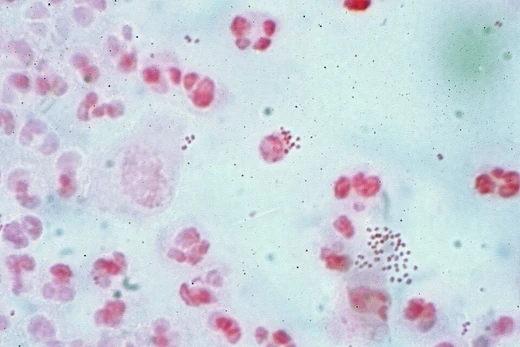
Clostridium perfringens
A Gram-positive anaerobe causing food poisoning and gas gangrene.

Clostridium perfringens is a Gram-positive, bacillus (rod-shaped), anaerobic, spore-forming pathogenic bacterium of the genus Clostridium. It is present in nature and can be found as a normal component of decaying vegetation, marine sediment, the intestinal tract of humans and other vertebrates, insects, and soil. It has the shortest reported generation time of any organism at 6.3 minutes in thioglycolate medium. Welch, it was originally known as Bacillus aerogenes capsulatus, followed by Bacillus welchii, before the final establishment of its current name. Clostridium perfringens is one of the most common causes of food poisoning in the United States, alongside norovirus, Salmonella, Campylobacter, and Staphylococcus aureus. However, it can sometimes be ingested and cause no harm.
- field
- Microbiology
- known_for
- Shortest generation time (6.3 min); common cause of food poisoning; gas gangrene via alpha toxin
- genome_size
- 2.9 to 4.1 million base pairs
- motility
- Provisionally non-motile; recent research suggests gliding motility in some cultures
Lore & Background
Welch. It was originally known as Bacillus aerogenes capsulatus, followed by Bacillus welchii, before the final establishment of its current name. The specific name, perfringens, is derived from the Latin per (meaning 'through') and frango ('burst'), referring to the disruption of tissue that occurs during gas gangrene. Gas gangrene is caused by alpha toxin, or α-toxin, that embeds itself into the plasma membrane of cells and disrupts normal cellular function by altering membrane structure. Research suggests that C. perfringens is capable of engaging in polymicrobial anaerobic infections. It is commonly encountered in infections as a component of the normal flora; in this case, its role in disease is minor. C. perfringens toxins are a result of horizontal gene transfer of a neighboring cell's plasmids. Shifts in genomic make-up are common for this species of bacterium and contribute to novel pathogenesis. Major toxins are expressed differently in certain populations of C. perfringens; these populations are organized into strains based on their expressed toxins. The toxin causing food poisoning is the CPE (Clostridium perfringens enterotoxin) cpe gene. Not all Clostridium perfringens types have the cpe gene, but all types could include this gene. The cpe gene is located in the plasmid-mediated cpe (p-cpe), or on the chromosomal cpe (c-cpe) strains. Chromosomal cpe strains are exclusively isolated from food samples, while p-cpe strains are found in non-food borne samples. c-cpe strains also produce heat resistant spores, while p-cpe strains produce heat sensitive spores. The enterotoxin–producing strain of Clostridium perfringens has been identified to be a small portion of the overall C. perfringens population (~1-5%). Clostridium perfringens is provisionally identified as non-motile. They lack flagella; however, recent research suggests gliding as a form of motility in some cultures. These hyper-motile variations form due to slight nucleotide polymorphisms and are regulated by various systems such as the CpAL/VirSR system and catabolite control protein A. In combination, these regulators help the spread of C. perfringens by increasing motility in regions of low nutrient densities and increasing toxicity as movement occurs. Studies have demonstrated a correlation between glucose levels and motility rates: as glucose levels rise, gliding motility decreases, allowing the bacterium to spread from areas of low sugar concentration into other regions.
Reader's Guide
Clostridium perfringens is significant as one of the most common causes of food poisoning in the United States and as the causative agent of gas gangrene (clostridial myonecrosis). Its extremely short generation time of 6.3 minutes makes it one of the fastest-growing organisms known. The bacterium's ability to produce a variety of toxins, including the alpha toxin responsible for gas gangrene and the CPE enterotoxin responsible for food poisoning, underscores its pathogenic versatility. The genetic diversity of C. perfringens is notable: its genome ranges from 2.9 to 4.1 million base pairs, and only 12.6 percent of its genes are core genes shared across all strains. This diversity arises from horizontal gene transfer via plasmids, such as the pCW3 plasmid, which also carries antibiotic resistance genes (tetracycline resistance, efflux protein, aminoglycoside resistance). The discovery of hyper-motile variants that use gliding motility, regulated by the CpAL/VirSR quorum sensing system, reveals a link between motility and toxin production, worsening infections as the pathogen spreads. In industrial contexts, such as poultry production, sequencing genomes for pathogenic strains has become an expanding field of research, as antibiotic-resistant strains become more common. The legacy of C. perfringens lies in its dual role as a common foodborne pathogen and a model for studying bacterial pathogenesis, genetic exchange, and motility.
Did You Know?
- Clostridium perfringens has the shortest reported generation time of any organism at 6.3 minutes in thioglycolate medium.
- The specific name 'perfringens' is derived from Latin meaning 'through' and 'burst', referring to tissue disruption in gas gangrene.
- Only about 1-5% of the overall C. perfringens population produces the enterotoxin responsible for food poisoning.
- Hyper-motile variants of C. perfringens form due to nucleotide polymorphisms and are regulated by the CpAL/VirSR system.
Discovery, Naming & Ecological Range
Welch, marking a significant milestone in anaerobic pathogen research. The organism passed through several taxonomic labels before receiving its current binomial: it was initially catalogued as Bacillus aerogenes capsulatus, then renamed Bacillus welchii in honor of its discoverer, before the genus was reorganized and the species settled on C. perfringens. The specific epithet is a vivid nod to the bacterium's most dramatic clinical effect, drawn from the Latin prefix per, meaning through, and the verb frango, meaning to burst, a direct allusion to the catastrophic rupture of tissue seen in gas gangrene. As a Gram-positive, rod-shaped, anaerobic, spore-forming organism, C. perfringens occupies a remarkably broad ecological niche. It thrives in decaying vegetation, marine sediment, soil, and the intestinal tracts of humans, other vertebrates, and even insects. It also holds the record for the shortest reported generation time of any known organism, dividing in as little as 6.3 minutes when cultured in thioglycolate medium, a trait that underscores its extraordinary capacity for rapid population expansion under favorable conditions.
Toxin Arsenal & Clinical Spectrum
The clinical impact of C. perfringens spans from a harmless commensal presence in the gut to devastating, life-threatening infections. Among the most feared manifestations is gas gangrene, also termed clostridial myonecrosis, in which the bacterium's alpha toxin inserts itself directly into host-cell plasma membranes, distorting membrane architecture and disrupting normal cellular function. The organism is additionally linked to tissue necrosis, bacteremia, and emphysematous cholecystitis, and it can participate in polymicrobial anaerobic infections where its individual contribution to disease may be comparatively minor. In the United States, C. perfringens ranks among the leading causes of foodborne illness, sharing that distinction with norovirus, Salmonella, Campylobacter, and Staphylococcus aureus. The enterotoxin behind food poisoning is encoded by the cpe gene, which may reside on a plasmid or on the chromosome. Chromosomal variants are isolated exclusively from food samples and produce heat-resistant spores, whereas plasmid-borne variants appear in non-foodborne clinical isolates and yield heat-sensitive spores. Only a small fraction of the overall population, roughly one to five percent, carries the enterotoxin-producing capability.
Genomic Plasticity & Horizontal Gene Transfer
Despite belonging to a single species, C. perfringens displays extraordinary genetic diversity. Its genome spans between 2.9 and 4.1 million base pairs, yet only about 12.6 percent of its genes are shared as core elements across all strains, making it one of the most variable Gram-positive bacteria known. Even so, the 16S rRNA regions remain highly conserved and nearly identical from one strain to the next, providing a reliable molecular fingerprint. A major driver of this variability is horizontal gene transfer, particularly through conjugation. The pCW3 plasmid serves as the primary vehicle for spreading antibiotic-resistance genes, including tetracycline resistance, efflux pump proteins, and aminoglycoside resistance, while simultaneously encoding several of the major toxins found in pathogenic strains. Plasmid DNA, in general, plays an integral role in cell pathogenesis. This fluidity in genomic makeup means shifts in toxin expression are common, and strains are classified according to which toxins they produce. In industrial settings such as poultry production, the rising prevalence of antibiotic-resistant C. perfringens has made genome sequencing an expanding area of research aimed at controlling foodborne outbreaks.
Motility & the CpAL/VirSR Regulatory Network
For decades, C. perfringens was provisionally classified as non-motile because it lacks flagella. Recent investigations, however, have revealed that certain cultures exhibit a gliding form of movement, and hyper-motile variants such as SM101 and SM102 have been documented forming long, thin filaments that enable motion, typically appearing around colony borders on agar plates. Genome sequencing of hyper-motile descendants, SM124 and SM127, identified only 10 and 6 nucleotide polymorphisms relative to their parent strains, along with common mutations in cell-division-related genes. The regulatory architecture behind this motility is the CpAL/VirSR system, a quorum-sensing two-component system shared with other pathogenic clostridia. This system is multifunctional: it governs the expression of toxins required for diseases like myonecrosis and simultaneously controls gliding motility. The practical consequence is a direct positive correlation between movement and toxin production, meaning that as the bacterium spreads through tissue, its virulence escalates in tandem. Glucose levels have also been shown to influence motility rates, adding another layer to the bacterium's adaptive behavior in nutrient-poor environments.
Frequently Asked Questions
What are Clostridium perfringens's powers/role?
Its signature weapon is an alpha toxin that drives the rapid, devastating tissue destruction characteristic of gas gangrene. It is also a leading cause of large-scale foodborne illness, especially after improperly handled meats are left at room temperature. Under ideal lab conditions it can double its population in roughly six and a half minutes, the fastest replication rate recorded for any organism.
How does Clostridium perfringens's story end?
In a clinical setting the infection is typically halted through aggressive surgical removal of dead tissue paired with targeted antibiotic therapy. For food-poisoning episodes the run is usually self-limiting, resolving within a day or two as the bacteria simply pass through the gut. The resilient spores, however, can linger in soil or sediment and re-enter the cycle much later.
Why is Clostridium perfringens important?
It sits at the crossroads of surgical wound care, public-health food-safety monitoring, and fundamental microbiology research. Its record-breaking growth rate makes it a go-to model for studying bacterial cell division under anaerobic conditions. Work on its toxin pathways has also fed directly into broader efforts to understand how bacteria hijack host tissues.
More in Pathogenic Bacteria 1-20
Spotted an error? Know more?
This is a living reference — every entry is fact-audited, and reader corrections feed straight into our audit queue. Suggest an edit · See this site's audit record